


E-commerce · Technology retail & IT services
Inmarknet Computers
A technology retailer, a service desk, and the system that runs both.

About the project
A commerce and services platform for a Kenyan technology company selling laptops, smartphones, printers, toners, and accessories—and installing, repairing, and supporting them.
View live projectInmarknet had been trading since 2010 across two different businesses: selling hardware and servicing it. The platform brings both into one storefront, one checkout, and one admin the team runs themselves.
- Client
- Inmarknet Computers
- Status
- Live commerce & services platform
- Role
- Product design & full-stack development
- Services
- Commerce strategy · UX/UI · Engineering · Admin & CMS
- Industry
- Technology retail & IT services
- Platform
- Responsive e-commerce
Case study framework
From the problem to the shipped product.
A transparent view of the UX thinking, interface decisions, and front-end engineering behind the work.
- 01Problem
- 02Context
- 03Discovery
- 04Pain points
- 05Flows
- 06Wireframes
- 07Exploration
- 08Final UI
- 09System
- 10Implementation
- 11Learnings
One business sold technology, another serviced it, and the website needed to explain both.
Inmarknet had a broad catalogue, specialist consumables, installation expertise, and repair services. The challenge was to build one legible commerce experience without making the service business feel like a secondary page bolted onto a store.
Who the product had to work for—and what the business needed it to change.
- Individual buyers
- SME procurement teams
- Printer and toner customers
- IT support clients
- Increase trust in genuine stock
- Reduce wrong-product purchases
- Support local payment and delivery expectations
- Let the team operate content and orders
Discovery focused on the decisions people were already trying to make.
- Availability, warranty, and delivery answers mattered earlier than long specifications.
- Toner buyers think in printer models and part numbers, not category trees.
- Local payment choices are part of the UX, not a back-office detail.
The experience had to remove three sources of friction.
Catalogue overload
Dense specifications made it difficult to understand what product was right for the task.
Compatibility risk
A wrong toner or cartridge creates a costly return and immediate loss of confidence.
Split trust
Retail, installation, and repairs felt like different businesses despite sharing the same expertise.
Guide the buyer from a need to a supported purchase.
- 01
Choose route
Shop products or explore business solutions
- 02
Narrow choice
Search, filters, categories, and compatibility
- 03
Validate
Stock, warranty, delivery, and specifications
- 04
Checkout
Contact, shipping, payment, and review
- 05
Get support
Installation, repair, or maintenance
The structure separated selection help from transaction detail.
Low-fidelity screens tested how quickly a shopper could orient themselves, compare products, validate a compatible consumable, and move through a short checkout without losing delivery or warranty context.
A bold retail surface supported by calm utility.
Lead with outcomes before specifications
Use high contrast for energy and legibility
Keep reassurance next to the decision it supports
Make services a primary navigation route
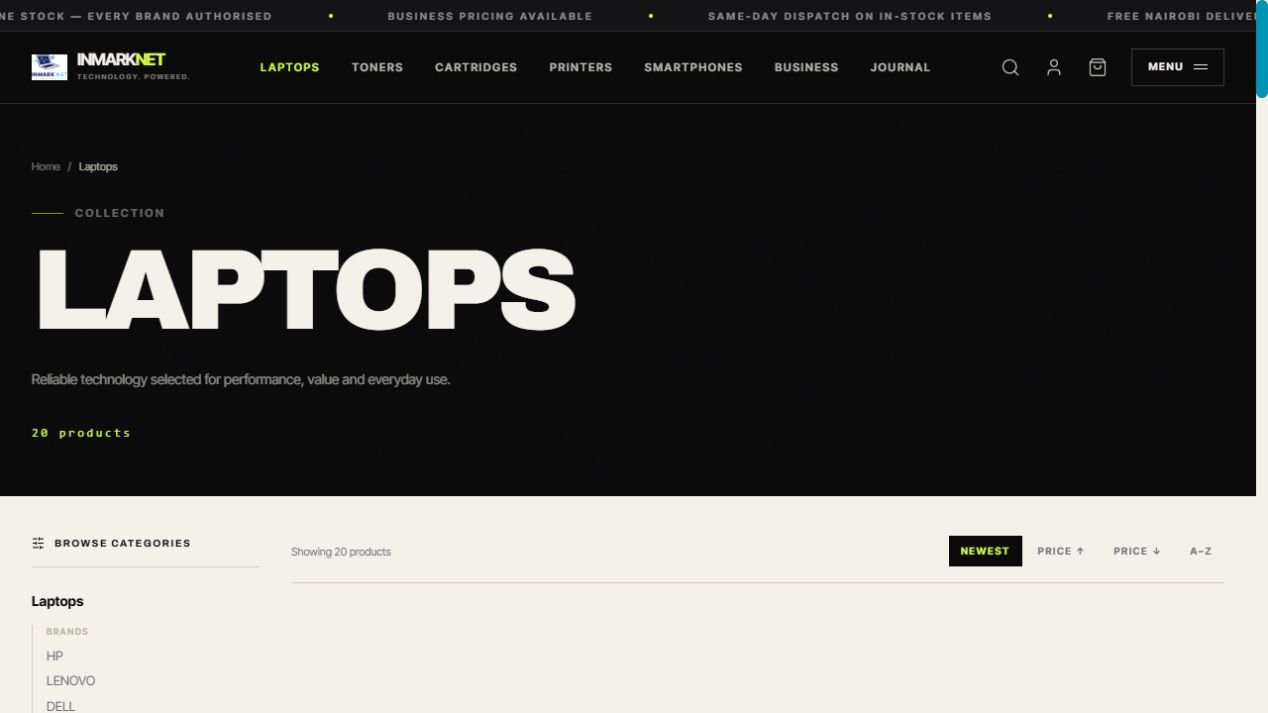
The live store makes the value proposition and catalogue immediately distinct.
These live captures show the brand-led opening and the practical catalogue state beneath it: clear categories, visible product count, sorting, and filters without losing the visual identity.

Commerce, content, and services share one component language.
#063bd8#dfe7ff#09090b#f7f5f0- Electric green signals primary action against a black retail canvas.
- Utility surfaces use quieter neutrals for long-form comparison.
- Product, service, and journal cards share interaction rules but retain distinct content hierarchy.
The engineering work extends from storefront to daily operations.
The platform connects product browsing, local checkout expectations, service discovery, and a custom administration layer. The team can manage product data, specifications, images, orders, customers, and editorial guidance without editing code.
Resolve VAT and shipping before order confirmation.
Support cash or M-Pesa on delivery alongside online payment.
Model specifications by category so the catalogue stays maintainable.
What the work changed—and what I would carry into the next version.
Local commerce trust is built from operational answers as much as visual polish.
A compatibility tool can remove more friction than another promotional banner.
Treating services as a core journey made the digital brand match the real business.
The impact
One platform for everything the business already did.
Retail, consumables, installation, and support now share a single storefront, a single checkout, and a single admin. The result reads as one company rather than a catalogue with a services page bolted to the side.
Continue exploring
Juri Jewelry